Tuesday, October 27, 2009
Metal Roofing Searches on Google
Materials
Pros and Cons
Prices/Cost
Installation
Colors
Manufacturers
Systems
As you might imagine, every single one of those keywords will lead you to a mountain of information - both right and wrong. But here's the good news: we cover all of the above in our informational, educational and truly exceptional booklet - our Homeowner's Guide to Re-Roofing. It's a 50ish-page guide that will take you through the ins and outs of not just metal roofing, but also the leading roofing materials on the market. And best of all, it's free for the taking! We get it - no one thinks about their roof until they need a new one. But when that time comes, isn't it smart to arm yourself with as much knowledge as possible? We think so, too.
Get your free copy on our homepage today.
Wednesday, October 14, 2009
Metal Roofing News in Your Inbox!
Wednesday, April 29, 2009
Another Great Looking Roof!


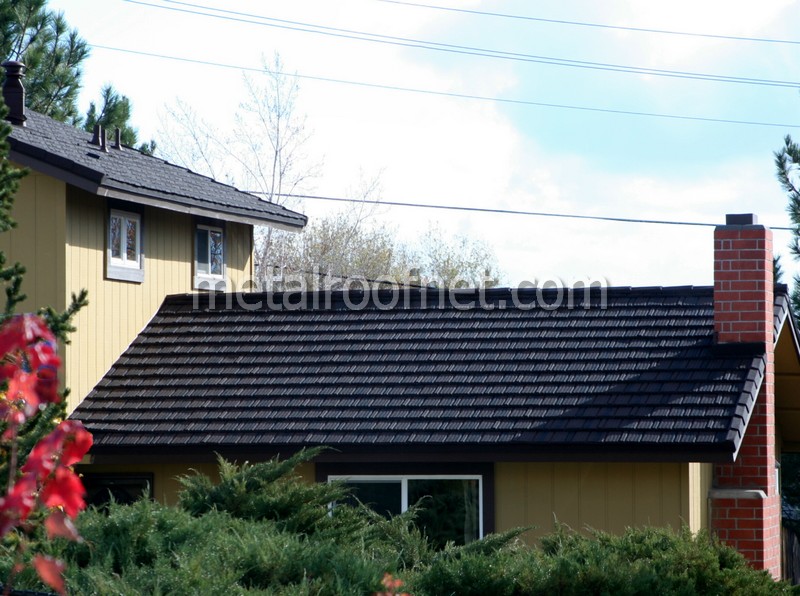
A few great shots of our beautiful Sierra Metal Shake. It's our proprietary design, designed right here in Nevada for Nevada's challenging climate. If this roof can handle the Silver State's freeze-thaw cycles, unforgiving high desert sun and cold, snowy winters, it can handle pretty much anything! Add to that a superior design and a surprisingly economical price tag, and it's just about the perfect roof. Check out more information plus a link to more pictures here or fill out our contact form here.
Tuesday, April 28, 2009
Drum roll please...
Positive Feedback
Wednesday, March 18, 2009
Metal Roofs and Economic Crises
Wednesday, January 28, 2009
Asking a Builder
Tuesday, January 20, 2009
Pricing
One of the questions I hear the most is along the lines of, "I’m thinking of a metal room for my (home, building, garage, shop, gazebo, etc.) and wanted to know some prices." And unfortunately, there's just no single answer to a question like this. It's a little like asking, “I’m thinking about buying a new car and wanted to know some prices.” The answer in both cases begs the question, “What kind to you want?” In the case of metal roofs, just as with cars, prices vary wildly. The cheapest metal roof can be had for less than $1 a square foot, while the most expensive can cost $20 or more.
The things that effect metal roof prices are these:
The metal. Steel, Aluminum, Copper, Zinc, Tin, even Titanium, Lead, and other metals and alloys all have been used to make roof material at one time or another and most are still used today. Due to the enormous price differences amongst the metals, the roof materials into which they can be formed vary accordingly. With each differing metal comes differing hardnesses, formability, and corrosion resistance. n the case of steel and aluminum it is most common to have these metals “finished” (painted), and again there are differing grades of paint suitable for differing purposes. When asking for a metal roof price, be certain to inquire as to the particular metal you intend to use. If you don’t know, then at least have an idea of what appearance you’re hoping to achieve.
The “Gauge.” This term refers to the thickness of the metal from which the roof material is formed. Common thicknesses are from 29 Gauge (roughly .015 inches, or .38 mm) to 22 Gauge (roughly .033 inches, or .84 mm). But metal roofs can be made from metals thinner than these and thicker, too. The particular metal determines which thickness is most appropriate for each roof application. Be aware that not all metals are commonly referenced by “gauge” and that “gauge” is not an equal unit of measurement even among metals (for example, 24 gauge steel is not necessarily the same thickness as 24 gauge steel). It’s a good idea when asking for roof prices to have an idea of what sort of “duty” you’ll require of the material. Something in heavy snow country or a very high wind environment may require a heavier, more robust metal, where something that only ever encounters a light breeze and constant sun may suffice with the lightest of metals.
The “Profile.” Vertical ribs, rectangular or diamond shingles, tiles, shake facsimiles – all of these different shapes and looks are often referred to as a “profile.” Some metals and some metal gauges are well suited to certain profiles and some are not. Some profiles are only made in one or two metals, and some are available in any metal. Differing profiles have differing “yields.” This means that certain profiles use more or less metal than other depending on the complexity of the shape. Even within each of these categories of profile, there are an enormous variety of options. For instance, Omega Roof has at least a dozen different versions of vertical rib profiles, and there are pros and cons to each version. When requesting prices for metal roofs, the more specific you can be about the look, or model, the faster you can get useful numbers for your job.
The size and complexity of the job. If you’re purchasing roof shingles for a bay window, it may cost $100 for the basic material, $100 for the accessories (eave, hip, flashing), and $100 for freight. So in this case, your 30 square foot job might cost $100 per square foot! If on the other hand, you’re purchasing for a 4000 square foot home with a triple attached garage and a simple roof line, you may be purchasing 6000 square feet of roof material and the accessories and freight may total less than $3 per square foot. Add the variables of type of metal, gauge, and profile, and it becomes apparent quickly that all of the specifics of a metal roof project are important in determining the budget.
If you keep these ideas in mind when you’re after pricing, it will certainly save a lot of wasted communcation. The most expedient way of obtaining prices for a metal roof project you have in mind is to either measure the job or photograph the job with approximate measurements and email the dimentions and photographs to someone like me. Being clear on the style you prefer and the location of the project at the same time will make it very easy to get useful numbers quickly.
My book, “What Every Homeowner Needs to Know…” is available as a free download on our website and elaborates on all of these points and more. Also in the book are formulas and prices so you can at least ball-park your own prices for metal and other roof options as well. Well worth the read if you’re getting ready to spend the thousands of dollars any type of roof is going to cost. Good luck!
Tuesday, January 13, 2009
Ask Chris
Say what?
Monday, November 24, 2008
Ask Chris
Q: I was speaking to a roofer recommended by a friend because I am going to need to replace my roof soon, and when I asked about a metal roof, he said they were “ugly and expensive.” Why would someone in the business say that if it weren’t true?
A: At the risk of alienating my associates in the industry, I have to say that “roofers” as a group are not a very complete source of information about the industry. The nature of the business is such that it tends to be very segmented. Roofers that work for contractors who roof “average” houses use the same materials over and over again, so when they go on to start their own businesses, they continue doing what they know. It just makes good business sense to invest in men and equipment that specialize in one type of product. So why would a roofer say something flattering about a product or service that is outside of his usual practice? Especially when it might cost him work? It’s just very unlikely that he would, so the comments of the roofer you met are more common than not.
I’m still amazed to this day, after nearly 30 years in the industry how many “insiders” still think metal roofs only come in the long, ribbed panels often seen on commercial buildings. Metal offers the biggest number of styles and options, not the fewest! If you want to get a “big picture” view of the many options available to replace your roof, and features like environmental friendliness, long term performance, beautiful styles are priorities, then you need to do your own homework. Our website features a downloadable free informational booklet that's one place to start, but there are many others. You’re going to spend thousands of dollars replacing your roof – doesn’t it just make sense to research the best possible option before you make such a major purchase? Even a roofer has to agree with that!
Thursday, November 20, 2008
Ask Chris
Q. The big wind last night caused some of my asphalt shingles to blow into my neighbor’s yard. My house is only 14 years old, and I understood from the builder that my roof had a “30 Year” warranty and was a “90 MPH” roof. Why is it already blowing off, even though the winds last night were not even close to exceeding 90 mph?
A: Welcome to the great Asphalt Roof Deception. The warranty for your roof (if you can find the piece of paper) no doubt had “30 Years” and “90 MPH” in big letters on the first page, but had you read to the fine print, you would discover that the “90 MPH” wind warranty expired after only 5 years – so you have no warranty at all from the manufacturer with regards to wind blow off, regardless of wind speeds. You must ask yourself, “If the manufacturer limits the wind coverage to 5 years, what is that saying about the real life expectancy of an asphalt shingle?” The answer is discovered by homeowners every day: The actual lifespan of a petroleum based product that is deteriorating from the first day it’s exposed to heat and sun is truly only 12-18 years or so. More or less depending on the peculiarities of the installation and location. If you want something that can actually stand up to the wind and sun for multiple generations, then you must investigate metal roofs, because the wind warranty for most of these lasts for the entire length of the warranty period. And that means real protection for homeowners. Find out more facts about roofing options by downloading our free roofing booklet from our website.
Metal Roofs and Home Values
I was beginning to believe the popular press and their analysis of the current economic downturn to the point that I was researching online information concerning cooking rats. It seemed that would be all most of us would be able to afford to eat soon and I might as well get prepared. After all, driving back from San Francisco last week I heard a long-time “conservative” talk show host, who I had previously considered to be a rational thinker, exclaim with in his most authoritative and conclusive voice that the recent downturn in the economy was “conclusive proof” that “unrestricted capitalism” was an animal destined to inevitably eat its own young – or other such nonsense. He was advocating for some form of increased “government oversight” of the financial system – just like many of the talking heads on CNBC.
Ask Chris
Q: My house needs a new roof, but with all of the bad economic news I’m wondering about the wisdom of spending money on my house right now. Is it a good idea?
A: If you’re not planning to move – it absolutely is a good idea. The maintenance needs to be done regardless of anything else, and if you’re staying in your home it makes even more sense to upgrade to a permanent metal roof and eliminate this major maintenance concern for generations to come. If your house isn’t going to be for sale anytime soon, then the best advice is to put on the best roof your budget allows regardless of what the headlines say today.
Ask Chris
A. Probably not if you upgrade to metal. Metal roofs typically weigh less than half the weight of disposable roofs like asphalt shingles or wood shakes. Most of the metal shingles, shakes and tiles are specifically designed for installation over existing materials, so the odds are very good that choosing a beautiful new metal roof to replace what you currently have will entail a small amount of preparation and an installation directly over top. And then you can enjoy the other benefits of a quality metal roof, for many, many years to come. Call or visit our website for more information about this topic and others.